A border robot has to work outdoors, send useful data, and stop safely when its sensors lose the scene. The biggest changes to watch are in autonomous patrol, aerial sensing, ground vehicles, and the systems that let people check what a robot reports.
- Autonomous patrol: robots may handle repeated routes while people review alerts.
- Mixed sensors: thermal cameras, LiDAR, radar, and ordinary cameras each cover different gaps.
- Human control: geofencing, remote stop commands, and audit logs decide how these systems are used.
Autonomous patrol moves beyond fixed routes
A robot that follows a marked path has a narrow job. A border system must deal with rocks, mud, fences, poor light, animals, and changing weather without treating every odd shape as a threat.
The useful step is better task planning. The robot can map a route, check its battery, avoid a blocked section, and send a person a short alert when something needs a closer look. That cuts the need for staff to watch a live video feed for hours.
The limit is judgment. A robot can flag movement or a heat source, but it can't decide what that event means without rules and human review. A false alert may waste time; a missed alert may create a safety problem.
Sensors will work as a group
No single sensor fits every border setting. An ordinary camera can show color and shape in daylight, while a thermal camera records heat patterns that remain visible in darkness. LiDAR measures distance by sending light pulses, and radar can detect movement through some dust, rain, or light vegetation.
The gain comes from comparing those signals. A warm object seen by a thermal camera, at a known distance from LiDAR, gives an operator more useful information than either image alone. The system still needs a person to check the result before action follows.
A border alert is only as useful as the test behind it. A report on Robot 24 can place detection range, battery life, weather limits, and radio links beside the trial or field deployment that produced them. That record leads to the next question: what should an air robot do, and what should a ground robot handle?
Air and ground robots will split the work
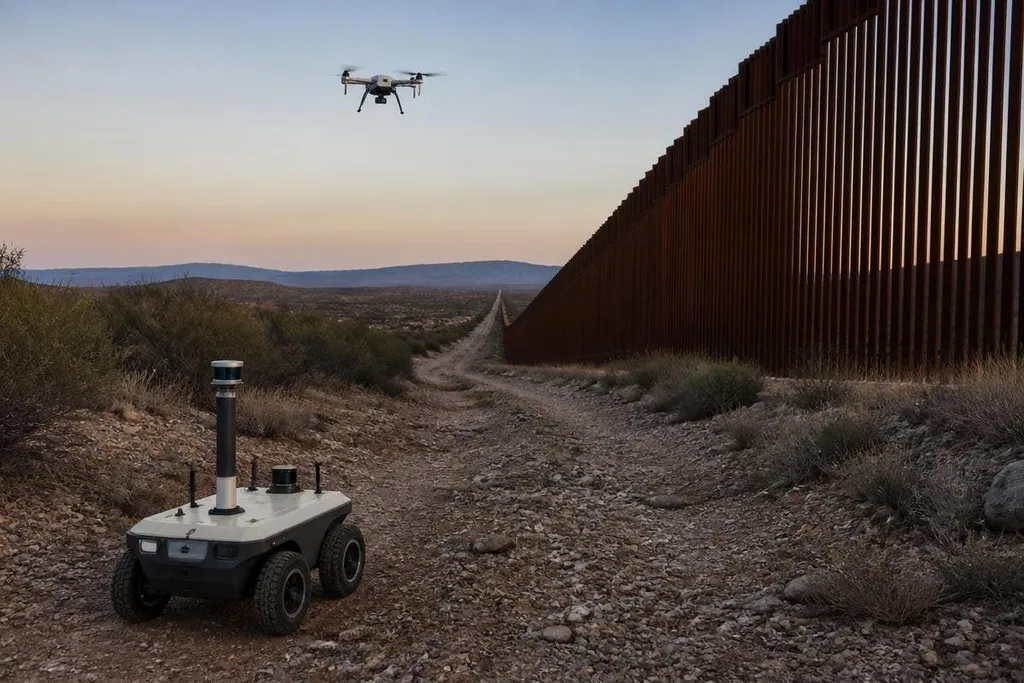
Aerial robots can view a wide area quickly, but wind, battery limits, and signal loss restrict their use. Ground robots can carry larger batteries or sensors and stay near a route, yet uneven ground, fences, and steep slopes make travel harder.
A useful system may send an aerial robot to check a distant alert, then keep a ground robot near a fixed crossing or inspection point. That arrangement adds work for operators, since they must manage different vehicles, maps, charging points, and emergency controls.
The open question is cost per useful patrol. A machine that flies for a short period but needs frequent battery changes may save little labor. A ground robot that moves slowly may work well for inspection while failing at long routes.
Safety and privacy will decide deployment
Border robots operate near people, roads, aircraft, and public land. Their software needs a geofence, which is a digital boundary that blocks travel into set areas. It also needs a remote stop command that works when the robot's normal plan fails.
Recorded video raises a separate concern. Operators need clear rules for access, storage, deletion, and incident review. A sensor that records a face or vehicle plate can create a lasting record even when the original alert was wrong.
I’d judge any proposed system by its failure handling before its detection claims. A company should show what happens when GPS drops, the radio link breaks, a sensor is blocked, or a person enters the robot's path.
A practical check before buying or deploying
Use this short decision guide before a pilot:
- Define the route: record ground type, slopes, fences, weather, and signal gaps.
- Name the alert: specify which event the system must report and which events it can ignore.
- Test the failure: remove GPS, block a camera, and cut the radio link under controlled conditions.
- Set human review: state who checks an alert and how fast they must respond.
- Measure the cost: count charging, repairs, staff time, storage, and vehicle recovery.
- Set data rules: decide who may view recordings and when the system deletes them.
A pilot that passes these checks has a useful basis for wider testing. A system that only works in clear weather, with an open radio link and a watched demo, still needs proof before it belongs on a border route.
The next worthwhile result will be a measured trial that reports false alerts, missed events, uptime, recovery time, and operating cost in the same document. Until those figures are public, the safest claim is that border robotics remains a field to test, not a finished answer.